

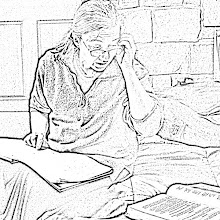

It took an unusually long time for my mom to answer the door. As I stood on the front porch, I could finally see her shuffling toward the front door like an old woman. That wasn’t her normal gait. When she swung the door open, Mom didn’t greet me.
“No one is here. No one,” she said and wandered away.
I peeked around the corner into the living room and sitting in his usual spot on the easy chair was my 88-year-old dad. He was the only other person who lives in my parents’ home.
“Who isn’t here?” I asked.
But I’d been warned. My sister had called me this morning, and despite my husband’s explanations that because of my lupus I was sleeping in, she insisted on speaking to me, telling me that our mother wasn’t making sense, was going on about blowing up the inflatable mattress for our brother Peter and his wife Tamara who live in Toronto but were supposedly visiting. On a weekday without telling us? Not likely. My sister was at work, so she asked that I drive to our parents’ house and check whether Mom really was as bad off as she sounded on the phone. My sister would wait for my call at work and make a doctor’s appointment, if I thought it necessary.
“Peter and Tamara aren’t here. Or little Danya and Mark. They were here last night, but they went to sleep at U-U’s house,” said Mom. U-U was my middle brother’s nickname. They had never slept at his house before…
I scanned the living room for stray toys or any sign that my brother’s family had indeed been there, then walked over to my hard-of-hearing father.
“Dad!” I shouted. “Were Peter and Tamara here last night?”
“No, I didn’t see them,” he said. “Mama said that I slept through it.”
Dad is notorious for nodding off, but I doubt that even he could sleep through the energetic visit of a 16-month-old toddler and a four-year-old.
“You look tired, Mom,” I said, hoping she’d give me some clue as to her state of health. Her eyes were mere slits. And on this chilly morning, she was wearing a sleeveless shirt and a vest turned inside out.
“I am. I had a party here yesterday. Yura and Maria came. And Peter and Tamara with their kids. And Irene Rak – she’s such a nice person. It was such a nice party. No pomp and circumstance. Very nice…”
My mom doesn’t throw parties, except for the family – and then she talks about it for weeks in advance. Mom had never met my sister-in-law Irene, who lives in Ukraine. But there was an even bigger problem with her story.
“Mom, Yura died last week,” I said. My mother had been the one to notify me of his death.
“I meant Volodia,” Mom corrected herself, naming Yura’s father who had died in World War II!
I picked up the phone and dialed my sister.
Was it a stroke? An overdose of sleeping pills, which she sometimes takes in the middle of the night? Sleeping pills and alcohol? We needed to find out. We’d been through something similar with our mom over a decade ago when she began to lull herself to sleep with large doses of alcohol because of insomnia, which had been a side effect of her blood pressure medication. She swore to us that she would never, ever drink again after she switched medication. Was she secretly hitting the bottle again? I didn’t smell it on her breath.
While I waited for my sister to come, I tried to get Mom to sit. She stumbled as she walked around the kitchen, putting away a knife and fork in the refrigerator. I wanted to make myself some coffee, but Mom took the steaming cup for herself. I was afraid that she’d spill it, so I put it on the coffee table in the living room for her.
“Sit, Mom, and have some coffee. I’ll bring the sugar.” She sprinkled a spoonful of sugar on the carpet as she completely missed the cup.
Although something was drastically amiss, Dad just kept pecking away at his laptop, checking the latest news as he always does, seemingly oblivious to Mom’s bizarre behavior. He didn’t hear what she said because he hardly hears even when you speak loudly and right at him. He was living in his own world; my mother was fantasizing hers. And I felt completely helpless in this bizarre situation.
I was so thankful when my sister arrived. I expected my mother to protest being taken to the doctor, but she followed my sister like an obedient puppy, stumbling on her way out, walking to the wrong car, but coming along.
My father can hardly walk, and when he does it’s only with a walker, so my mother, who is 11 years younger than Dad, serves him like a maid. I talked with my dad for a while, telling him that I’d be back with lunch for him since Mom would be gone for several hours – to the doctor, for blood work, and for a CAT scan.
I came home and found Jacob working on Health, even though I hadn’t had time to write out his assignments for the day. At least something was going right. He was looking at the course outline and figuring out his own assignment. I was impressed.
“Someday, it might be you going to take care of me,” I said an hour later as I headed out again with a sandwich for my dad. “Keep working on your schoolwork and I’ll catch you later!”
My sister returned with Mom just as I was serving Dad lunch. The blood was drawn and tests ordered. Now we have to wait. But by evening, Mom was sounding like Mom again. And she was making sense.
But what was it?
Thursday, May 29, 2008
Foreboding

Monday, May 19, 2008
On medical leave
I get nothing done while on medical leave.
I get up late and check Jacob’s schedule. He’s been working while I sleep.
I review his vocabulary with him.
I lie down and read a book for next year’s curriculum.
I go over Jacob’s Health assignment. We review together for his test. I log in to check my email on my work account. I don’t want to see the backlog of writing that my coworkers must now do for me. I log out.
I lie down, my heart aching in my chest.
I read some Biology and explain phenotypes and genotypes while lying on the couch.
I keep reading my book. My hands are cold. The sky is cloudy and temperatures are way, way below the normal for May. I am discouraged. My lupus is no better than when I first went out on medical leave.
I get up and go over the Global History and write the schedule for the next week.
I lie down. I check personal email from my laptop while reclined.
I get up and look at my garden. I pull up a dandelion. I feel the chest pains again.
I lie down. The house needs cleaning. The garden needs work. This quarter’s grades haven’t yet been sent in to the school district.
I get nothing down while on medical leave.
Saturday, May 17, 2008
Triggered memories
I read an excellent book review by the Thinking Mother in this week’s Carnival of Homeschooling.
Although I haven’t read Ships Without a Shore, based on the review, I certainly share the author’s viewpoint. Years ago I wrote numerous articles for the Montessori school newsletter about some of those topics...
Montessori preschool – what a long time ago!
One girl in Jacob’s class was an only child. Her parents both worked full-time for a large corporation so they could afford their large, sterile-looking MacMansion where they could have housed a dozen kids. That little girl, who spent mornings at Montessori preschool and afternoons in daycare, prayed that her mother would lose her job. She just wanted to be with her mother. The child cared nothing for the large house.
The greatest gift parents can give their children is their time. Instead, many parents believe that signing up kids for softball, piano lessons, and sending them off on sleepovers is what’s best for them. The parents end up as chauffeurs; the kids end up frazzled and rushed. Where is the one-on-one time? The teaching moments?
I enjoy spending time with a friend chatting over a cup of coffee. In the same way, I love spending time with my children, talking, cooking together, gardening, or just hanging around the living room. When the kids were preschool age, they were far more eager to spend time with me than they are now as teens. But, surprisingly, because of the time that my husband and I spent with them back in their younger years, the relationship we have today is still remarkably close.
It wasn’t always easy to make the time to be with the children. We were an odd family, I suppose. Because my husband was an immigrant and I had more earning power, we decided that he would stay home with the kids and I would work. Oh, it hurt when the kids cried at night for Daddy, not Mommy, because Dad was at home to kiss their boo-boos. But I consoled myself thinking that most Dads are never that close with their kids. Their closeness remains to this day, and sometimes they still choose to confide in Dad instead of Mom. Yes, it still hurts, but I’m still glad that the children are that close to Dad. I never was close to my own dad.
As the kids got older, we juggled our time so we could both work. Both of us were self-employed – George as a general contractor, I as a writer. George took on daytime projects and I stayed with the children. Then in the late afternoon, we would switch: George would take the cranky, worn-out kids and spend the evenings with them, tucking them in as I wrote training documents in my home office.
My fondest memories are from those days of juggling when the children were about 2, 4, and 6. I did all kinds of things that I enjoy with the kids, things that I would never have allowed myself the luxury of doing if not “for the children’s sake.” Finding caterpillars and raising them into Monarch butterflies. Wading in the creek at a nearby park and climbing the shoulder-high waterfall. Hiking in the neighborhood park. Netting tadpoles. Roasting hot dogs over a bonfire in the backyard woods. Catching fireflies in the park.
Today, my older two would rather spend time with their friends than go to the park to catch tadpoles. But 12-year-old Larissa still prefers those quiet one-on-one times with Mom. For now.
Saturday, May 10, 2008
What I check out of the library
“That’s an incredibly depressing set,” said the librarian when I was checking out items at the public library yesterday. “Well, maybe Gandhi…” she added, motioning to the DVD I had in the pile.
I suppose she was right.
I took out Gandhi to supplement my son’s history lessons.
Hiroshima by John Hersey is a compilation of six first-hand accounts of people who survived the dropping of the atomic bomb on Hiroshima. The reportage follows six people right before, during, and directly after the bombing. Yes, the details are gruesome, but the book puts a human face on the statistics that we read. I read this book two months ago, now I’m giving it to Jacob to follow along with a book-on-tape of this book. This is also part of Jacob’s history curriculum.
Sold by Patricia McCormick is about a Nepali girl who is sold by her stepfather into prostitution in India. Although it’s a novel, it’s based on interviews with real women who were sold into the sex slave. I’m going to pre-read this book to see whether I want to include it in my Heartache curriculum.
A Child Called “It” by Dave Pelzer in an autobiographical account of extreme child abuse. Some of the ways that Dave’s mother conjured up to torture him were beyond anything I’ve ever heard. His alcoholic mother ostracized him from the rest of the family, then tormented him with not only beatings, but starvation, poisoning, and worse.
I had stopped in the library right before my doctor’s appointment. I finally decided to take medical leave from work due to my recurrence of lupus, and I needed him to fill out the paperwork. But the wait to see the doctor was long, and meanwhile I read the first 40 pages of A Child Called “It.” I read the rest of the book before suppertime. It will definitely be on my Heartache curriculum, and I’m going back to the library today to get the sequel, as well as two books that Dave Pelzer’s brother wrote. Apparently after David was rescued by social services from the severe abuse, the mother turned her wrath on the next older son. He, too, wrote about his experiences.
Why am I drawn to these “depressing” books, I often wonder. Is it a morbid curiosity? Why?
By knowing what is happening in other people’s lives can we truly appreciate what we have and perhaps extend a hand to help others in need. Dave’s life would have been different if someone had been kind to him even during his school days, but his classmates mocked him due to his sloppy appearance and stench (his mother refused him a change of clothing or baths) and added more pain to his tormented life. By being educated about the injustices of the world, we can also be more compassionate towards the victims. And ultimately, compassion is what I hope to instill in my children as well as an awareness of the horrors that they don’t experience firsthand.
I grew up in a sheltered, loving home with no exposure to abuse. I thought all families were basically like ours, except that my parents came from a foreign country so we spoke Ukrainian at home. I was in my twenties when I first read about wife beatings and child abuse. I was horrified. Later, after a friend of mine was married and living in another city, she opened up to me and said that her father was an abuser. Her sister would run barefoot through the snow to a neighbor’s house to get away from him. I visited this girl as I was growing up, spent time in her home, and I never suspected… It’s all around us, but the victims usually remain silent.
In my house, I want the victims to be heard.
Wednesday, May 7, 2008
Trauma
The fire started in the room next to the one in which my coworkers and I were sitting. The large, glass wall made the fire all the more evident. Next thing I knew, a fireball had burned out the building; my coworkers continued to sit in the chairs and sofas, but had turned into burnt skeletons. I was horrified. No, no, no! I shrieked silently. No, not my friends! I rewound the video in my brain, back to before the fire started, but there it was again, the fire, the horror…
I knew I shouldn’t have read A Long Way Gone in bed before turning off the light. Ishmael’s nightmares were becoming my own. The gruesomeness of seeing people killed before your very eyes, the trauma of learning your entire family was slaughtered, and, worst of all, the desensitization that occurred when children were made into soldiers, trained to kill, then given drugs to turn them into ruthless killing machines with no remorse – these were the circumstances of Ishmael’s life. This sensitive child had turned into brutal warrior who delighted in others’ pain.
I’ve read first-hand accounts of war before, but never from the perspective of a drug-addicted teen. I was horrified as I read that almost overnight, Ishmael was transformed from a kind, war-traumatized child into a soldier who delighted in causing destruction and death – all because of the drugs that he’s given, initially right before his first battle, then supplied with regularly. The cocaine, marijuana, and other drugs, plus a steady diet of Rambo and other war movies, obliterated any compassion and love Ishmael had.
Rehabilitating drug-addicted, unremorseful soldiers is no easy feat. To my surprise, these children wanted to return to the front. They wanted their guns and drugs. War had become a normal way of life for them.
As I read the book, I tried to view it from my children’s perspective. Some of the grisly war scenes are hard to read. Even harder is Ishmael’s delight in killing. The book is shocking. How will my children react to it if I assign it to them? But, as I mentioned before, life for many around the world is difficult and so very different from life in suburbia. How else will my children know?
Tuesday, April 29, 2008
Heartache
In Haiti, 16-year-old Charlene resorts to eating dirt to fill her belly.
Bai was married at five to a 36-year-old, and widowed by nine. She spent her entire life begging for a living. In India, widows do not remarry; their very presence is considered inauspicious, so they are shunned by society. Even when they are nine.
Forced from his home in Sierra Leone at 12, taught to maim and to kill at 13, Ishmael is just one of the world’s estimated 300,000 child soldiers. The atrocities he lived through – and was forced to commit – are hard for us to imagine.
Kamala was cursed at birth for being born a girl. As she grew up, she was constantly reminded that she was a financial drain on her family. The sooner she was married off, the better. But marriage requires a dowry, something Kamala’s family couldn’t afford, so when she was 12, they sold her into prostitution in Bombay instead.
Mende was kidnapped from her village in southern Sudan and sold by her captors into slavery to an abusive Arab family in Khartoum. What she endured at the hands of her masters was beyond cruelty.
These are just some of the stories I’ve read. No, they aren’t tales from history books, but events that are going right now as I sit in my comfortable home. People are eating dirt while I eat ice cream. Widows are ostracized, children are conscripted as soldiers, girls are sold into prostitution, youngsters are kidnapped and sold into slavery.
My heart breaks when I read these accounts. But there’s more, much more.
Lawlessness in Somalia, which hasn’t had a central government for 17 years.
Desperate laborers lured to sell their kidneys.
Leprosy. Yes, today.
Christians thrown in jail and tortured.
Children sold like commodities by desperately poor parents.
I read, and I weep. I want my children to weep, too. I want them to be aware of these atrocities, these injustices, these horrors. Only in this way can they, like I, be moved to action, whether it’s to donate funds to help the oppressed, speak out for them, lend a hand during a mission trip, or devote their entire lives to making a difference.
How will my kids learn unless I teach them?
So next year, I will introduce a new subject into my homeschool curriculum. I’ll call it Heartache.
Once a week, we’ll learn about child soldiers. Street children. AIDS orphans. Those who dig through trash to eek out an existence. And who better to teach my children than I?
I fed the street children in Addis Ababa.
I hugged the orphans in Honduras.
I befriended a woman who digs through trash in a Mexican landfill.
I played with the AIDS orphans in Ethiopia.
I had my heart broken by the starving children in a Kenyan widow’s home.
I saw countless thousands of people sleeping on the streets of Calcutta.
I visited a fistula clinic where women with childbirth injuries are repaired, sometimes after years or decades of suffering.
But I didn’t even touch the tip of the iceberg of the world’s suffering. How can I possibly convey it to my children?
Maybe, God willing, I’ll at least touch a heart.
Friday, April 25, 2008
I can see clearly now
“Put on your glasses and look out this window,” Alexandra urged her younger sister while they were at the optometrist. “Look at the grass! I can see every blade of grass!”
“Wow….” said Larissa. “I think I’m going to get a headache seeing that much detail.”
To me, seeing every blade of grass, every eyeglass frame in the adjoining room is normal. To my daughters, it’s a novel experience. I got a peek into their world by listening to their conversation.
“I thought it was normal that distant objects were blurry.”
I hadn’t realized that their eyesight had gotten bad. They had passed the vision test during their physicals in October. Only recently had each of them told me on different occasions, “I can’t read that sign” or “In school, I can’t see the board.” (They are both still in public school this year while I homeschool their oldest brother.) I made them an appointment at the eye doctor immediately. They both got new glasses a few days later – Tuesday of this week.
So why do I feel like such a bad mom to not have caught their poor vision sooner?
Monday, April 21, 2008
More textbooks?!
“Few skills are more important to Christian students than the ability to effectively communicate through the written and spoken word.”
I came across that statement in Applications of Grammar / Book 4, Principles of Effective Communication by Christian Liberty Press while flipping through the pages.
It makes a lot of sense. So rather than putting off adding this book to Jacob’s curriculum next year, I decided to assign exercises from this book beginning this week. When I was putting together the week’s schedule, I mentioned it to Jacob.
“You’ll be happy to know that starting this week, you’ll have one more textbook,” I told Jacob.
“You’re kidding.”
OK, I wasn’t expecting great glee.
“It’s a grammar book. I’ll give you less reading and a grammar exercise or two every week,” I smiled.
His reaction was not one of delight.
Although I give Jacob a vocabulary exercise daily from the Wordly Wise series, I’ve completely neglected grammar. And because I’ve been pushing classic books on him, forcing him to read more than ever before, I’ve neglected writing as well. Considering he’s finishing up tenth grade, I don’t have any time to lose!
Fortunately, Jacob does have a solid basis in writing and grammar, thanks to our local public schools. I’ve always read and corrected his writing through the years, making suggestions and explaining why I put in a comma or changed a sentence, how to vary sentence structure, and how and when to use adverbs (a pet peeve). But he definitely needs more practice.
English is not Jacob’s forte, so anything I assign him – reading, writing, or exercises in grammar and vocabulary – is painful. But indeed, how will he be able to communicate his beliefs – or anything else – effectively if he doesn’t have a solid foundation in English?
